Email marketing consistently outperforms every other digital channel on ROI. The Litmus 2024 State of Email report puts average email ROI at $36 for every $1 spent (approx. €33) — higher than paid search, social media, or content marketing. And yet, most small businesses either don't use email at all, or send the occasional newsletter and call it a strategy.
The businesses generating real revenue from email in 2026 are not the ones sending better newsletters. They're the ones who have built automated sequences that run continuously, converting subscribers into customers without manual intervention.
This guide covers the architecture of a high-performing email automation system — from welcome sequences to re-engagement flows — and how to build one that works for your business.
Why email ROI is 36:1 (and why most businesses don't capture it)
Email's extraordinary ROI comes from two structural advantages over other channels:
- You own the list. Unlike social media followers or ad audiences, your email list is an asset you control. Algorithm changes, platform shutdowns, and CPM increases don't affect it. Every subscriber is a direct communication channel you own permanently.
- Automation scales infinitely at near-zero marginal cost. Once an automated sequence is built, it sends personalised messages to 1 subscriber or 10,000 subscribers for the same cost. There is no other channel with this leverage ratio.
The reason most businesses don't capture this ROI is architecture. Sending one broadcast newsletter per month is not email marketing. It's email broadcasting. Real email marketing is a system of triggered sequences that activate based on subscriber behaviour — when they join, when they click a link, when they don't open for 60 days, when they abandon a cart.
The welcome sequence: your highest-leverage automation
The welcome sequence is the most important automated email flow you can build. Subscribers are most engaged in the 48–72 hours after joining your list — open rates during this window average 40–60%, compared to 20–25% for subsequent emails. This is the moment to deliver maximum value and establish the relationship.
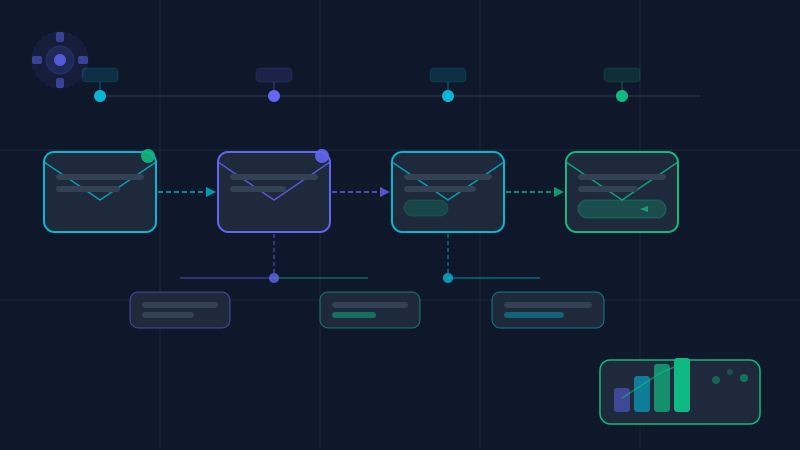
A high-converting welcome sequence for a service business:
- Email 1 (immediate). Deliver the lead magnet or promised resource instantly. Brief, warm, no selling. Confirm what they'll receive from you going forward.
- Email 2 (day 1). Your origin story or the story of why you do what you do. Makes the relationship feel personal. No CTA except "reply and tell me about your situation."
- Email 3 (day 3). Teach them something genuinely useful — your best tip, a common mistake in your industry, or a framework you use with clients. This builds credibility through value, not claims.
- Email 4 (day 5). Social proof. One client transformation story, told as a narrative rather than a bullet-point testimonial. Specificity is the key — name the problem, the process, the result.
- Email 5 (day 7). Soft offer. Introduce your core service or product with a clear CTA. Because you've delivered value for a week before asking, conversion rates are significantly higher than cold outreach.
This 5-email welcome sequence runs automatically for every new subscriber. Built once, it works permanently.
Nurture sequences: keeping leads warm until they're ready
Not every subscriber is ready to buy when they join your list. Research shows that 50% of leads are qualified but not yet ready to purchase at the time of first contact. A nurture sequence keeps your brand front-of-mind during the consideration phase — so when they are ready, you're the obvious choice.
Effective nurture sequences:
- Send 1–2 emails per week (not more — list fatigue is real)
- Alternate between educational content (80%) and commercial content (20%)
- Segment based on expressed interests — someone who clicked on "SEO tips" should get more SEO content, not a generic newsletter
- Include clear, low-friction CTAs — "book a 15-minute call" converts better than "contact us"
Re-engagement flows: rescuing inactive subscribers
After 90 days of inactivity (no opens, no clicks), subscribers move to the "at risk" category. Sending to cold lists hurts your deliverability and reduces the effectiveness of your emails for engaged subscribers. Before removing them, run a re-engagement sequence:
- Email 1: "Have we lost you?" — honest, direct subject line. Ask if they still want to hear from you.
- Email 2 (3 days later): Give them something valuable — your best piece of content, a new resource, an exclusive offer.
- Email 3 (5 days later): Last chance message. Tell them you'll remove them from the list in 48 hours. This urgency drives re-engagement from people who didn't open the first two.
Those who don't engage after all three emails get removed. A smaller, engaged list consistently outperforms a large, unresponsive one in both deliverability and revenue.
Segmentation strategy: the difference between good and great
Unsegmented email marketing treats all subscribers identically regardless of their interests, behaviours, or stage in the buying journey. Segmented email marketing delivers the right message to the right person at the right time. The performance difference is dramatic — segmented campaigns generate 76% more revenue per email sent.
Segment your list by:
- Acquisition source. Someone who downloaded a "Google Ads guide" has different interests to someone who signed up from your "email marketing" page. The content they find relevant is different.
- Engagement level. Active subscribers (opened in last 30 days) get your full nurture sequence. Cooling subscribers (30–90 days) get re-engagement content. Cold subscribers (90+ days) trigger the re-engagement flow.
- Purchase behaviour. Existing customers should receive different content to prospects — upsell sequences, renewal reminders, referral requests. Do not send acquisition offers to people who already bought.
- Expressed interests. Tag subscribers based on the links they click. Clicks on pricing pages suggest buying intent — these subscribers should receive more commercial emails and direct outreach.
AI-personalised email in 2026
The biggest shift in email marketing in 2026 is AI-driven personalisation at scale. Tools like Klaviyo's AI, ActiveCampaign's predictive sending, and custom LLM integrations now allow:
- Predictive send time optimisation. The system learns when each individual subscriber is most likely to open email and sends at that exact time — not at a fixed 9am blast.
- Dynamic content blocks. Different sections of the same email render differently based on subscriber segments — the same send delivers different content to different people.
- Subject line testing at scale. AI generates 10+ subject line variants and automatically allocates send volume to the highest-performing ones within the first 30 minutes of a send.
- Churn prediction. AI models identify subscribers at risk of disengagement before they go cold, triggering proactive re-engagement content.
Tools comparison: which platform for which business
- Mailchimp. Best for: businesses just starting email marketing with lists under 2,000 subscribers. Generous free tier. Interface is intuitive. Automation capabilities are limited compared to paid alternatives. Avoid for complex sequences.
- ActiveCampaign. Best for: service businesses with complex customer journeys. Exceptional automation builder with conditional logic, lead scoring, and CRM integration. Mid-tier pricing. The go-to for B2B SMBs.
- Klaviyo. Best for: e-commerce businesses. Deep Shopify/WooCommerce integration, abandoned cart flows, and revenue attribution reporting. Higher price per contact but delivers higher e-commerce ROI. Industry standard for DTC brands.
- Brevo (formerly Sendinblue). Best for: high-volume senders who need transactional and marketing email combined. Competitive pricing based on sends rather than contacts.
The tool matters less than the architecture. A well-built automation in Mailchimp will outperform a poorly architected sequence in Klaviyo.
Deliverability: the foundation everything else rests on
Deliverability determines what percentage of your emails reach the inbox versus the spam folder. Even the best-written email is worthless if it lands in spam. Key deliverability practices in 2026:
- Authenticate your domain with SPF, DKIM, and DMARC records — mandatory for Gmail and Yahoo delivery since 2024
- Warm up new email domains slowly — don't send 5,000 emails on day one
- Maintain list hygiene — remove hard bounces immediately, soft bounces after 3 attempts
- Keep unsubscribe rates below 0.5% — high rates signal to email providers that recipients don't want your content
- Monitor your sender reputation score via tools like Google Postmaster Tools and MXToolbox
Want an email automation system built for your business?
We design and build complete email marketing automation — welcome sequences, nurture flows, re-engagement campaigns, and deliverability setup. Get a free strategy session.
Get free email audit →